Operating model
The idea says controls run once and intelligence stays in the domain. This page is the ownership version of that sentence: which team owns which box, and what changes hands when you publish a capability.
Get the split wrong in either direction and you lose the point — a platform that owns the intelligence becomes a bottleneck, and domains that own the controls rebuild identity and audit five times.
If you want the story first: how it hangs together.
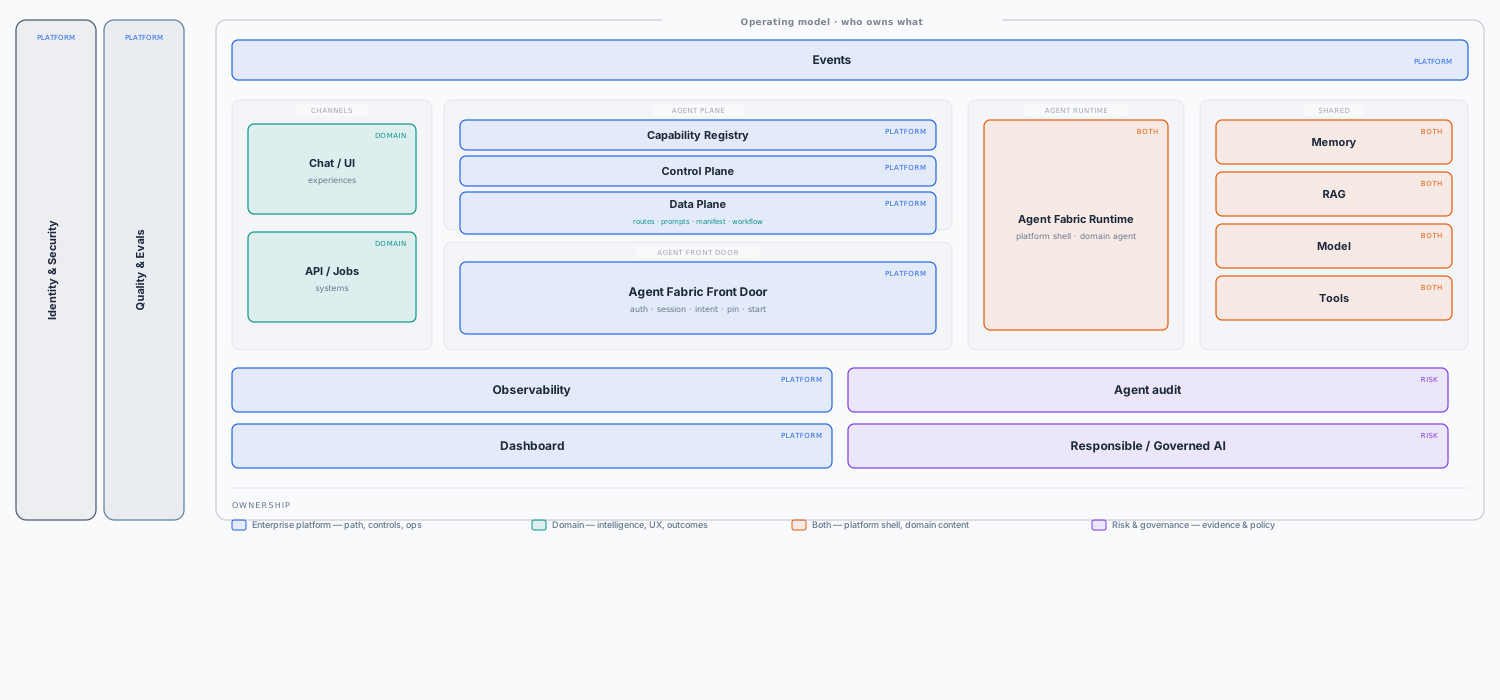
Caption: Platform owns the path. Domains own the work. Shared services are jointly owned.
Who owns what
| Band | Component | Owner |
|---|---|---|
| Channels | Chat and UI experiences | Domain |
| Channels | API and jobs systems | Domain |
| Agent Front Door | Auth, session, intent, pin, start | Platform |
| Agent Plane | Control Plane (catalogue UI) | Platform |
| Agent Plane | Data Plane — routes, prompts, manifests, workflows | Platform |
| Agent Plane | Agent Capability Plane | Platform |
| Agent Runtime | The runtime shell | Platform |
| Agent Runtime | The domain agent inside it | Domain |
| Shared | Memory, model, tools, observability | Both |
The Runtime row is the one people misread. The platform owns the shell — pin, hydrate, graph execution, telemetry, the evidence emit. The domain owns the agent — the prompts, the capabilities, the workflow, the judgement about what good output looks like. One process, two owners, a clean seam at the catalogue.
What the platform guarantees
Because the path is owned once, these hold for every route without a domain team implementing them:
| Guarantee | Where it comes from |
|---|---|
| One way in | Front Door is the only public ingress. Channels never dial the Plane or Runtime |
| Entitlement on every request | Jobs skip classification, never entitlement |
| An immutable execution snapshot | The route pin fixes route_id@version before the first model call |
| Evidence without opt-out | Audit events fire from every box; no route field disables them |
| Journey telemetry | Observability keyed by route_id, correlated end to end |
| Three separated identities | The user, the agent, and the Runtime workload never collapse into one token |
What a domain owns
Everything that makes the product good, and nothing that makes it safe:
- The capabilities they publish, and the business APIs behind them.
- The prompt pack and the quality of what the model is told.
- The schemas that constrain model output.
- The autonomy mode — how much latitude the model gets.
- The corpora their answers are grounded in.
Publishing: what actually changes hands
Publication is the transfer point, and it is deliberately one-way.
- A domain publishes a capability to the Registry as
id@version. Published versions are immutable — a fix is a new version, never an edit. - A route pins that version. The route is itself versioned, and only one version per
route_idisactive. - A run pins the route version. From that moment the run is immune to catalogue changes; publishing a new active version does not disturb work in flight.
- The pin becomes evidence. The
hydrate.snapshotaudit event records every resolved capability version and schema digest, so the composition is provable later.
Because every step is append-only, "what was running last Tuesday" is a query rather than an archaeology project.
Neither routes nor corpora have a write API — both are seeded from SQL under agent-fabric-scripts/stack/route/. Capabilities and manifests do have a PUT, and it is the only path that emits capability.published and manifest.published audit events. Seed loading writes the rows silently.
Scaling rules that follow
These are consequences of the ownership split, not separate policies:
- One Agent Plane per trust domain, not one mega-agent. The plane is a boundary, and boundaries are how the model stays reviewable.
- Two Front Door fleets, one contract. Chat is connection-bound; jobs are bursty. Separate processes so a hung chat pool cannot take down jobs.
- Capabilities are references, not copies. Runtime hydrates the whole pinned manifest before the model sees anything, and never re-reads the registry mid-loop.
- Only
routestarts a run.clarifyandabstainnever pin, so an ambiguous request cannot quietly execute something.
The internals paper: technical design. What runs today versus what is designed: autonomy.