The idea
The Fabric is the shared front door and control plane for acting AI. At portfolio scale — hundreds of routes and agents — identity, routing, policy, approval, and proof run once. Domains keep the intelligence.
If you only remember one page besides how it hangs together, remember this one.
Why this exists
AI that answers can live as a chatbot. AI that acts — money, customer data, regulated process — needs shared enterprise plumbing.
Every acting capability needs the same answers:
- Who may use it
- Which specialist should run
- What it may touch, and how a high-risk step is approved
- How we prove what happened
Do that plumbing once, and the organisation answers those questions from one place instead of from five domain stacks.
Centralise controls. Keep intelligence in domains.
| Once, for the whole portfolio | Still owned by the domain |
|---|---|
| Identity and entitlement | The business problem |
| Routing to the right capability | Knowledge, models, prompts |
| Policy, approval, kill switch | Specialist runtime |
| Audit and ops view | Outcomes and UX |
People and systems never dial Legal, payments, or KYC URLs. They come in one front door. The fabric verifies, routes, runs, and records. The domain AI does the work.
One request
Chat and jobs are the same idea. Only how the path is chosen differs.
- Ask — a person or a system arrives at the door.
- Verify — are they entitled for this channel?
- Route — pick a governed path, ask a clarifying question, or refuse. Jobs name the path; they still must be entitled. A refusal never starts work.
- Pin & start — lock the version and the agent identity, then start the runtime.
- Execute — domain AI runs with approved knowledge and tools.
- Record — outcome back; evidence kept.

Caption: Verify → route → execute → record. One path for a human turn and for a system job.
If you remember one sequence, remember that. Architecture is only names for those steps.
Architecture (names for the jobs)
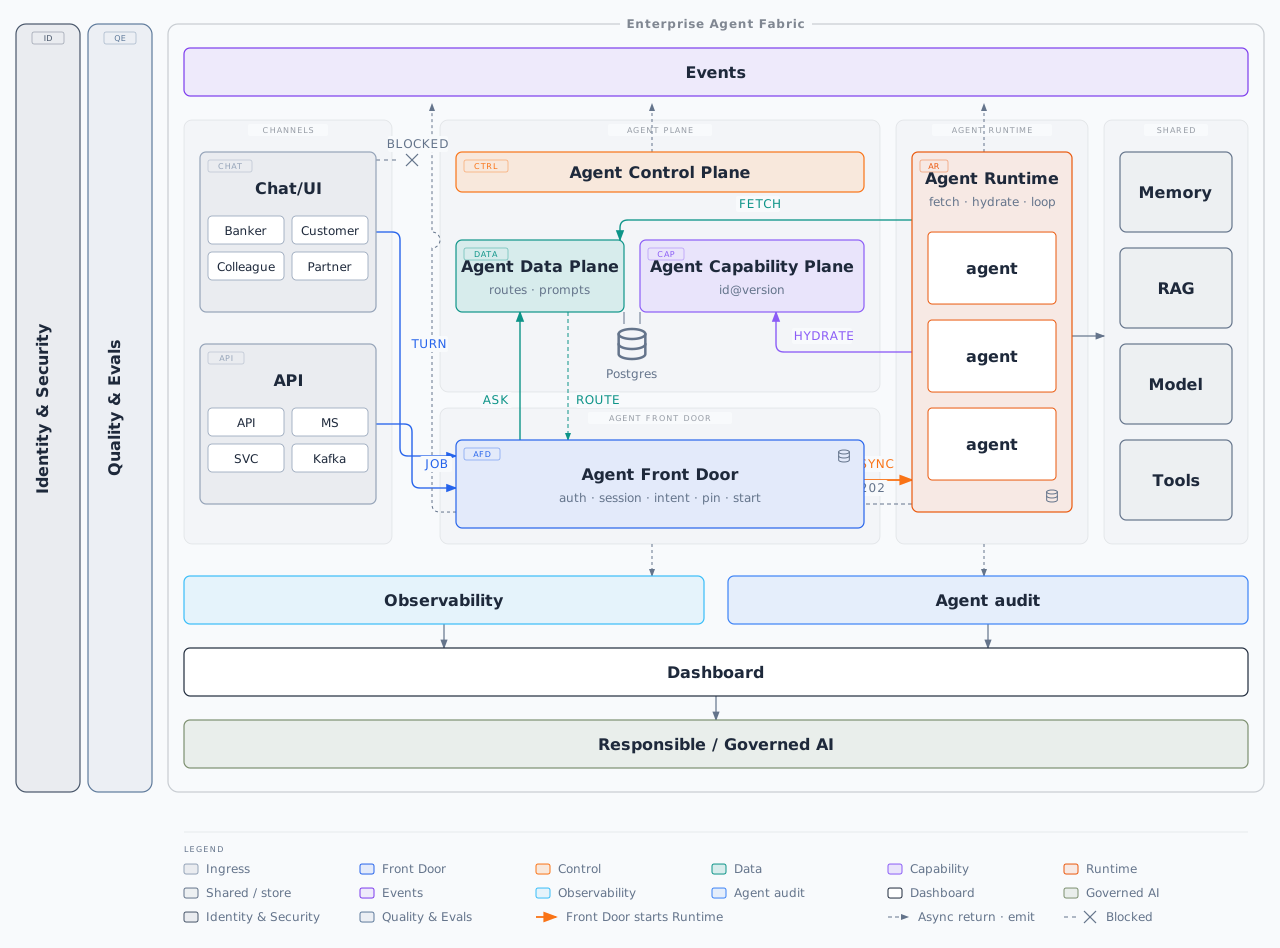
Caption: One ingress spanning the plane. Runtime beside it. Shared memory, retrieve, model, and tools. Audit and observability underneath.
| Job in the idea | Name in the picture |
|---|---|
| The only way in — entitle, lock the path, start work | Front Door |
| Which governed capability, at which version | Plane (catalogue, decide, operator view) + Registry (published tools) |
| Do the work | Runtime — ours, or another activation behind the pin |
| Memory, grounding, model, dual-checked actions | Shared |
| Prove it and see it | Audit and Observability |
Three identities stay distinct: the user, the agent (software acting), the runtime (the box that runs). Pin the path before minting the agent token. Channels never skip the door.
The sentence to leave in the room
One front door. Controls once. Intelligence stays in the domain. Every request — chat or job — is verify, route, execute, record.
Who owns which box: operating model. How a request actually crosses the boxes: request lifecycle.