Mode 3 — Guided
The designer picks the stages; the model picks tools inside a stage from that stage’s allowlist. Outer order is fixed. Inner choice is named.
Use this for triage-then-draft or counsel-style review: a process on the outside, a short leash on the inside. The index: autonomy.
The route points at a workflow (required) and a manifest (required).
This is the hybrid: Pattern 2 on the outside, a small Pattern 1 loop on the inside of each stage that carries an allowlist.
START → stage 0 (LLM may CALL tools in allowlist until the stage completes)
      → stage 1 (new allowlist)
      → …
      → END
max_tool_calls (per stage) caps the inner loop. It is not max_loop_steps for the whole run — that budget belongs to autonomous.
No-tools guided is not a product: an allowlist over an empty set is Pattern 2 LLM-only, or Pattern 0.
How it is hooked together
The route row has autonomy_mode=3, prompt_id, workflow_id, and tool_manifest (required). Stages that grant inner choice carry an allowlist of capability ids. max_tool_calls caps that inner loop (per stage), not max_loop_steps for the whole run.
Front Door POST /v1/runs
        │
        ▼
   pin  route_id + route_version     goal immutable
        │
        ▼
   hydrate  ACR hydrates the manifest
            workflow stamps llm_role / llm_prompt AND per-stage allowlist
            outer order = stage list (manifest order + allowlist membership)
            _ensure_llm still appends respond if no classify/synthesis exists
        │
        ▼
   graph    INTENDED: linear outer walk (Pattern 2)
                      + inner build_agent_loop per allowlisted stage
                        (catalog = that stage’s allowlist, cap = max_tool_calls)
            THIS RUNTIME: build_tool_graph only
                      agent-runtime/app/core/agent_core.py  (mode != 1)
                      allowlist is catalogue-only; inner CALL/DONE is not wired
        │
        ▼
   attachments
            prefetch: pack before / as a non-skippable stage
            retrieve: capability on an allowlist (may skip search, not the stage)
            memory: working notes + loop checkpoint for inner loops
            kind=agent: CALL only on stages that list it
            branch / human_gate: designer-owned edges between stages
How this binary hydrates: patterns. Gaps: autonomy modes. Data channels: HTTP is dict(goal); the LLM reads notes. See data.
Swimlane
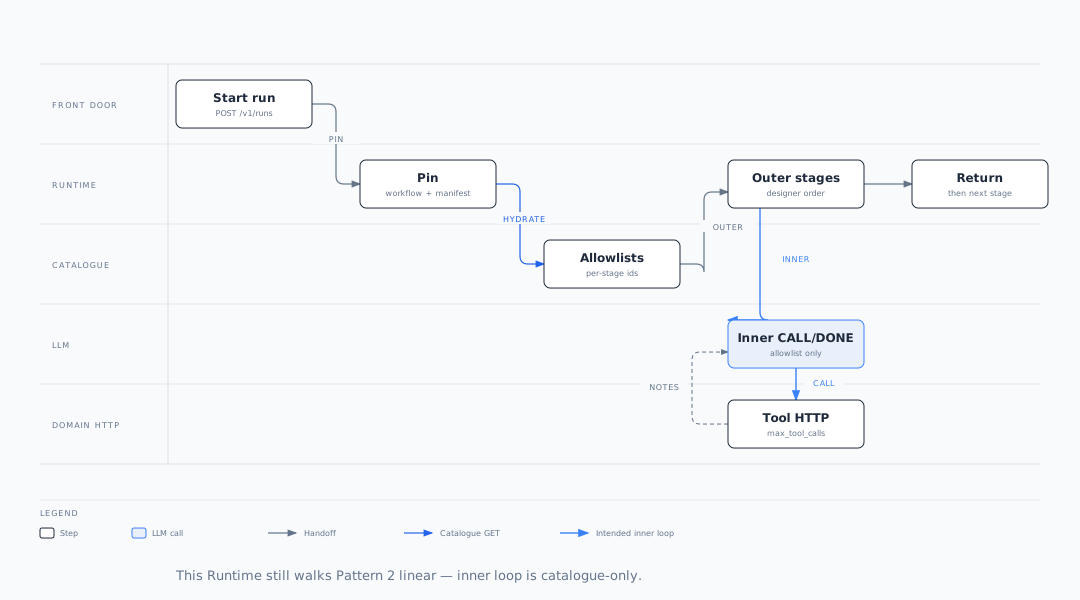
Intended: designer owns outer stages; the LLM CALLs inside an allowlist. This Runtime still walks the Pattern 2 linear graph — the inner loop is catalogue-only. Open as a page.
How the LLM is called
Intended — two kinds of llm.complete on the same run
| Where | What the model does | System / user |
|---|---|---|
| Stage with no allowlist | Same as Pattern 2 _run_stage: llm_role is none / query_formulation / classify / synthesis | llm_prompt for that role; user is _user_blob (goal + prior stage outputs) |
| Stage with an allowlist | Inner CALL / DONE over that stage’s ids only, up to max_tool_calls | Same contract as Pattern 1, plus pack host (or the stage role text); Tools: is the allowlist, not the whole manifest |
| After HTTP-only outer stages | Hydrate still appends respond synthesis if no classify/synthesis exists yet | Same _ensure_llm safety net as Pattern 2 |
The designer picks the next stage. The LLM picks the next tool inside an allowlisted stage. It cannot jump to a later stage, and it cannot CALL a capability that stage did not list.
Prefetch is still packing, not an inner CALL. A retrieve capability on an allowlist is an inner CALL (the model may skip it). Mixing allowlisted stages with Pattern 2 stages on one workflow is still Pattern 3 as long as some stage grants inner choice.
This Runtime: only the Pattern 2 column runs — llm.complete per llm_role in _run_stage, plus appended respond when needed. The inner CALL/DONE loop is not built.
Prompt packs: prompts.
What you may attach
| Attachment | Allowed | Role |
|---|---|---|
| Workflow | required | Stage order + per-stage allowlist |
| Manifest | required | Every tool that any allowlist may name |
| Retrieval omit | yes | Inner tools are domain APIs / parsers, not a corpus |
| Retrieval prefetch | yes | App packs scope before or as a stage the model cannot skip; later stages still have allowlists |
| Retrieval tool | yes | Retrieve capabilities appear on an allowlist. The model may skip search inside that stage; it cannot skip the stage itself |
| Memory omit | yes | One-shot guided job |
| Memory session | yes | Conversation, working, loop checkpoint for inner loops; long_term=retrieve_only when retrieve exists |
kind=agent | yes | Allowlist may include a child start. The model may propose it only inside that stage |
branch / human_gate | yes | Still designer-owned edges between stages |
A stage without an allowlist is a Pattern 2 stage (exactly one tool, or LLM-only). Mixing those with allowlisted stages is still Pattern 3 as long as some stage grants inner choice.
Supported compositions
Retrieval × memory, tools always on. Child start and process control are overlays.
| # | Retrieval | Memory | Product | Seed illustration |
|---|---|---|---|---|
| 1 | omit | no | Guided stages, one-shot | not in seed |
| 2 | omit | yes | Guided triage / copilot | ticket_triage |
| 3 | prefetch | no | Pack, then guided, one-shot | not in seed |
| 4 | prefetch | yes | Pack, then guided, sticky | product_explain |
| 5 | tool | no | Guided retrieve, one-shot | not in seed |
| 6 | tool | yes | Guided review | narrow_review, contract_review, due_diligence |
| 7 | any | usually yes | Inner allowlist may start a child | not in seed |
| 8 | any | usually yes | Guided stages plus branch / human_gate | not in seed |
1–2. Guided, no index
Fixed stages such as parse → tag → draft. Inside a stage the model may pick parse_ticket vs tag_intent only if both are on that stage’s allowlist; it cannot jump to draft before the designer said so.
1. One-shot job. No session.
2. Session + loop checkpoint for the inner loops. Seed: ticket_triage (parse_ticket, tag_intent, draft_reply).
Use when the business process is mandated (triage, copilot) but tool order inside a step can vary.
3–4. Pack, then guided
Prefetch (or a non-skippable pack stage) grounds the run. Later stages keep allowlists.
Use when the model must not skip policy/product text, but may choose how to compare or score after the pack.
Seed: product_explain — prefetch product-terms, fee-schedule; tools score_offer, compare_options; chat + session.
5–6. Guided retrieve
Retrieve tools sit on a stage allowlist. The model may search clause-index, or policy, or both, inside that stage, then must move on when the stage completes. It cannot invent a new stage.
5. One-shot.
6. Review packet with session and long_term. Seed:
narrow_review— one corpus (clause-index)contract_review—clause-indexandlegal-playbookdue_diligence— same corpora, policy-first allowlist
Use when enterprise review is a mandated sequence (intake → search → score → memo) but search order inside the search stage should flex.
Narrow vs wide allowlists are the same pattern. A smaller allowlist is not a new mode.
7. Child agent on an allowlist
A kind=agent capability may appear only on the stages that are allowed to hand off. The model cannot start KYC from the OCR stage unless that stage lists start_kyc_onboarding.
Not in the Pattern 3 seed; Pattern 1 composition 7 is unbounded child start, Pattern 2 composition 12 is a fixed-stage child start.
8. Guided plus process control
branch and human_gate still belong to the designer. Inner allowlists do not create new edges. Use when a copilot stage sits in front of a mandatory approval path.
Not guided
| Shape | Where it lives |
|---|---|
| One LLM call, no stages | single-inference |
| Model picks the next step for the whole run | autonomous |
| No inner choice; every stage names exactly one tool | deterministic |