Agent Capability Plane
This page is the registry contract. Publishing as a transfer of ownership: operating model.
Publishers append a capability as id@version. A route refers to those versions. Runtime hydrates the whole pinned manifest once, at pin, then never re-reads the registry mid-loop.
This box sits with the Agent Plane, beside Control Plane and Data Plane. It is a catalogue of tools and child agents — not a third Front Door, not MCP list_tools, and not Shared Tools.
What it is
Two kinds of capability:
- domain — a governed business API the agent may invoke.
- agent — start another catalogue route through the Front Door jobs API.
Kinds and schemas: capabilities.
What it owns
| Owns | Does not own |
|---|---|
Immutable id@version rows and manifests | Classify, pin, start |
| Hydrate reads at the pinned version | Mid-loop tool dispatch |
What it must not do
- Edit a published version. A fix is a new version.
- Be called from the LangGraph loop on every tool turn.
- Live in Shared. Memory, RAG, and Tools stay there.
How to talk to it
Runtime GETs at pin. Publishers PUT a version. Fixtures: capability-account-fee-lookup.json, manifest-fee-explain.json.
Design notes
Business problem
Teams inline OpenAPI into manifests, or they bind latest, or they treat MCP list_tools as the enterprise catalog. The loop fetches tools when the model first names them. Parent AR POSTs Legal's activation_target. A published capability is mistaken for permission. Every domain republishes the same OCR API.
Key requirements
| ID | Requirement (this box) |
|---|---|
| Locked-8 | Capabilities are references. Publishers append immutable id@version. AR hydrates the whole pinned manifest before the LLM. |
| Locked-8 | kind=agent invoke is API AFD jobs, not the callee AR. |
| FR-8 / FR-10 | LLM never sees {jobs_url} or activation_target. Jobs Authorization is the calling agent token. Child mints its robot. |
| — | Route row still has no tools[]. Only a tool_manifest pointer. |
| — | Publish is append-only. Overwriting 1.2.0 is not a version. |
Hydrate is pin-time, not turn-time. Scale with new starts and catalog reads, not with loop steps.
Architecture
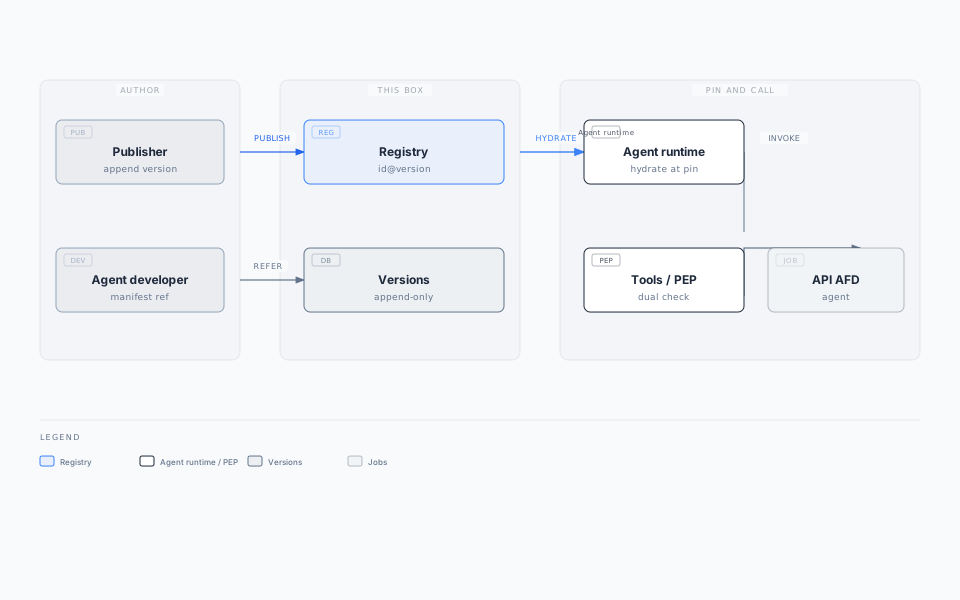
Three objects, two writers. Three moments — only the last is the AR loop.
Key technology decisions
| Choice | Why |
|---|---|
Package versions, not live list_tools | Exam and pin need a frozen schema. 1.2.0 never changes once published. |
| Manifest stores a reference, not "latest" | Publishing 2.0.0 must not move fraud_investigate_v1. |
| Hydrate whole manifest at pin | No mid-loop registry GET. Cache (manifest_id, manifest_version). |
Two kinds, one catalog | domain = governed business API. agent = start another catalogue row via API AFD. |
| PEP then invoke | A published capability is not permission. Dual check still runs. |
| Registry with Agent Plane | Same band as catalogue. Shared stays Memory / RAG / Tools. |
Expected outcomes
- Domain teams publish an API once; agent developers copy a ref.
- A2A is a named tool on the parent manifest, same jobs contract as partners.
- In-flight runs keep hydrated schemas if the registry later goes down.
- Reviewers see which catalog versions moved in the manifest PR.
This box owns / does not own
| Owns | Does not own |
|---|---|
Immutable capability versions (schema, invoke, snippet, owner, status) | Pin, start, PEP permit, dual check |
| Search / list for UI and CI | Route choice, classify, activation_target |
| Hydrate reads at pin | Loop-time tool fetch, MCP server per internal API |
If the registry dies: new runs cannot hydrate; in-flight pins still have schemas.
2. Job
Three objects, two writers. The route row still has no tools[].
| Object | Who writes it | What it holds |
|---|---|---|
| Capability version | Publisher | One immutable release: schema, invoke, snippet. ocr_extract@1.2.0 or start_contract_review@1.0.0 |
| Tool manifest | Agent developer | References: id + version + pdp_action + risk_tier |
| Route row | Platform / domain | tool_manifest pointer. Still no inlined tools |
| Moment | Who | What happens |
|---|---|---|
| Publish | Publisher | Pipeline puts one version in the registry. Append-only. |
| Refer | Agent developer | Copies { "id", "version" } into their tool_manifest. |
| Call | AR | After freeze: download the whole pinned manifest, hydrate every ref onto the run pin, then schemas only to the LLM. invoke runs after PEP. |
Same freeze vs new route. A summarizer helper is a domain capability on this manifest. Legal MSA review is an agent-start capability. The second one's invoke is the API AFD jobs URL, not Legal's activation_target.
3. What a capability version is
| Field | Why it exists |
|---|---|
id | Stable name: ocr_extract or start_contract_review. Product, not vendor. |
version | Immutable semver. 1.2.0 never changes once published. |
kind | domain (business API) or agent (start another catalogue row). |
description | What the agent developer (and later the model) reads. |
input_schema / output_schema | JSON Schema. Becomes the tool schema on the run pin. |
invoke | After PEP. Domain: governed business API. Agent-start: POST {jobs_url} with a fixed route_id. |
snippet | Copy-paste example for the developer. Documentation, not runtime. |
owner | The team that may publish the next version. |
status | draft / published / deprecated. Manifests may reference published only. |
Breaking the contract is a new major. Overwriting 1.2.0 is not a version.
Domain capability version (JSON)
{
  "id": "ocr_extract",
  "version": "1.2.0",
  "kind": "domain",
  "description": "Extract text from a document id.",
  "input_schema": {
    "type": "object",
    "required": ["doc_id"],
    "properties": { "doc_id": { "type": "string" } }
  },
  "output_schema": {
    "type": "object",
    "required": ["text"],
    "properties": { "text": { "type": "string" } }
  },
  "invoke": {
    "method": "POST",
    "url": "https://api.internal/ocr/extract",
    "auth": "domain-oauth"
  },
  "owner": "document-intel",
  "status": "published"
}
Agent-start capability version (JSON)
{
  "id": "start_contract_review",
  "version": "1.0.0",
  "kind": "agent",
  "description": "Start governed Legal MSA review as a jobs run.",
  "input_schema": {
    "type": "object",
    "required": ["document_id"],
    "properties": {
      "document_id": { "type": "string" },
      "matter_id": { "type": "string" }
    }
  },
  "output_schema": {
    "type": "object",
    "required": ["correlation_id"],
    "properties": { "correlation_id": { "type": "string" } }
  },
  "invoke": {
    "method": "POST",
    "url": "https://api-afd.internal/v1/jobs",
    "auth": "calling-agent-oauth",
    "body": { "route_id": "contract_review" }
  },
  "owner": "legal-agents",
  "status": "published"
}
4. Call another route
If this run needs a separate catalogue row, that callee is a named tool on the parent manifest. The model may only propose that name. The tool's invoke is API AFD, same jobs contract as partners and Kafka.
Two gates, in order:
- Manifest + PEP (this freeze). No
invoke_any_agent. A tool not on the pinned manifest never fires. - API AFD (the child start). Entitle the user and record. Freeze Legal's
agent_client_id. Async-start Legal AR.202+ a newcorrelation_id.
The LLM never sees {jobs_url} or activation_target. Parent AR never POSTs Legal's AR. Chat AFD stays for humans. This caller is software, so it is the jobs fleet.
Parent freeze stays fraud_investigate. Child freeze is contract_review. Two tickets.
If Legal is only a stage on the same row (workflow_id), stay in parent AR — not this path.
Identity: jobs Authorization is the calling agent token. After freeze, Legal mints its robot. Three principals.
5. Context
| Actor | Relationship |
|---|---|
| Publisher | Pipeline PUTs one version. Humans draft; CI sets status=published. |
| Agent developer | Copies { id, version } into tool_manifest. |
| AR | GET each ref once after downloading the pinned manifest. Loop does not call this box. |
| Registry UI | Search, detail, version history. Not a channel API. |
| Shared PEP | Executes hydrated invoke after dual check. Not the registry. |
| Chat/UI | None. Schemas never go to the browser as catalog JSON. |
6. How a reference lands in the manifest
| Step | What they do |
|---|---|
| 1. Find | Search the registry. Copy references. |
| 2. Write | Edit the manifest file. tools[] is name, capability_id, capability_version, pdp_action, risk_tier. |
| 3. PR | Reviewers see which catalog versions moved. CI checks each ref exists and is published. |
| 4. Pin | AFD freezes the route. First AR downloads that whole tool_manifest, hydrates every ref, then talks to the LLM. |
| 5. Call | Proposal must match a hydrated name. PEP. Then invoke from the pin. |
Parent manifest with domain tools and one agent-start (JSON)
{
  "manifest_id": "fraud_investigate_v2",
  "manifest_version": "2026.08.1",
  "tools": [
    {
      "name": "search_transactions",
      "capability_id": "search_transactions",
      "capability_version": "1.4.0",
      "pdp_action": "search_transactions",
      "risk_tier": "low"
    },
    {
      "name": "start_contract_review",
      "capability_id": "start_contract_review",
      "capability_version": "1.0.0",
      "pdp_action": "start_contract_review",
      "risk_tier": "high"
    }
  ]
}
7. APIs
The registry is not a channel API. UI, pipeline, and one hydrate at pin call it. The loop does not.
| Method | Path | Who / when |
|---|---|---|
PUT | /v1/capabilities/{id}/versions/{version} | Pipeline (publish). UI (draft save). Existing published → conflict |
GET | /v1/capabilities/{id}/versions/{version} | UI detail. AR hydrate (every ref, once) |
GET | /v1/capabilities/{id}/versions | UI version history |
GET | /v1/capabilities?q= | UI search of published |
AR start still goes to {activation_target} from Runtime §5. Agent-start invoke is a later POST to {jobs_url} on API AFD.
8. Deployment architecture
| Concern | Stance |
|---|---|
| Ingress | Internal only. Not a channel API. |
| Scale | Publish rate + pin hydrates (refs per new run). Does not grow with tokens in the loop. |
| Cache | Hydrated (manifest_id, manifest_version) if many runs share a pin. Do not resolve latest. |
| Failover | Reads from replicas. In-flight AR pins do not need this box. |
| Isolation | Independent of Layer ② decide CPU. |
9. Data architecture
Indexes: unique (id, version). Search: status=published + text on id / description.
Consistency: Published versions are immutable. No latest pointer in runtime.
Retention: Append-only. Deprecated versions remain GET-able so old pins and exam still hydrate.
10. Sequence diagrams
Happy path — hydrate at pin

Agent-start invoke (two gates)

11. Failure and resilience
| Failure | Behaviour |
|---|---|
| Registry down at pin | New runs fail hydrate. In-flight pins continue. Classify/decide unaffected. |
| Registry down mid-loop | No effect if hydrate already happened. Do not lazy-fetch. |
| Missing / draft ref | Fail start. Do not skip the tool silently. |
| PEP deny | No invoke. Published ≠ permitted. |
| API AFD deny on agent-start | Child does not start. Parent run handles the error. |
| Duplicate child start | Jobs idempotency_key on AR/AFD. |
Anti-patterns: AR POSTs callee activation_target; invoke_any_agent; Chat AFD for A2A; lazy tool fetch; latest as a reference; user bearer as jobs Authorization.
12. Scaling
Hydrate is pin-time, not turn-time. Scale with new starts and catalog reads, not with loop steps.
| Axis | Grows with | Scale signal |
|---|---|---|
| Registry | Publish rate + pin hydrates (refs per new run) | Hydrate p99, catalog QPS |
| Tools / PEP | In-flight invokes (domain and agent-start) | Per-capability latency / deny rate |
| API AFD (agent-start only) | Child job POST RPS from AR | Same jobs signals as partners |
Read next
Agent Runtime · Agent Front Door · Agent Plane · Agent Audit · Capabilities · Enterprise Agent Fabric