Agent Runtime
This page is the Runtime contract. Who picks the next step: autonomy. The story: how it hangs together.
Runtime is where the agent does the work. Only the Front Door starts it. It copies the freeze onto a durable run pin, hydrates every capability on that pin, returns 202 with a correlation_id, and runs the graph.
It does not classify the next utterance. Memory, RAG, model, and tools sit in Shared and are called from here, not built in.
What it is
Three steps, always in this order:
- Pin — copy
route_id@versionfrom the freeze. Do not re-readactive. - Hydrate — resolve the catalogue row and every
id@versionfrom the Agent Capability Plane. - Run — compile the LangGraph for the route's autonomy mode.
The platform owns the shell (pin, hydrate, graph, telemetry). The domain owns the agent (prompts, capabilities, judgement).
What it owns
| Owns | Does not own |
|---|---|
| Run pin, hydrate snapshot, graph loop | Classify, eligible set |
| Calls into Shared (memory, RAG, tools) | Channel auth, public ingress |
correlation_id on 202 | The freeze store |
What it must not do
- Classify or start itself.
- Re-read the catalogue or registry mid-loop.
- Use the user token as the tool-call caller. User, agent, and Runtime workload are three principals.
How to talk to it
Channels never see this URL. Front Door calls:
| Method | Path |
|---|---|
POST | /v1/runs |
POST | /v1/runs/{id}/turns |
GET | /v1/runs/{id} |
Fixtures: run-start.json.
Design notes
Business problem
Routing and work share a clock, so a 12-step loop kills the decide SLO. Channels dial activation_target and skip entitlement. The runtime is treated as the robot: one bearer at boot with every route's scopes, or the user token as the tool-call caller. Memory, RAG, and tools get copied into every agent process.
Key requirements
| ID | Requirement (this box) |
|---|---|
| FR-1 / FR-4 | Only AFD starts AR. AR fetches the catalogue row at the pinned version, copies the freeze, requests a token for the pinned agent_client_id, returns 202. Nobody re-reads active. |
| FR-8 | Channels never dial activation_target. |
| FR-10 | Three principals. User ≠ agent ≠ AR workload. Tool calls use the agent bearer plus user claims. |
| — | Default start is async. Pattern 0 is the only sync wait. Hydrate the whole pinned manifest before the LLM. |
Run SLO ≠ decide SLO. Loop may take seconds to minutes.
Architecture
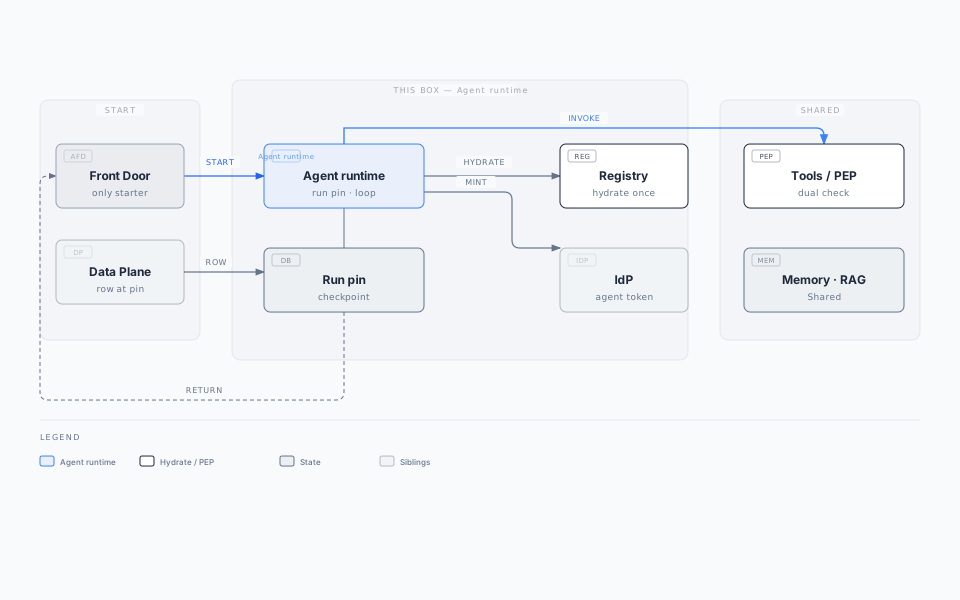
AR returns two ways: HTTP status and Kafka. Same slim body. AFD fans out.
Key technology decisions
| Choice | Why |
|---|---|
Scale per activation_target | Isolate the box (PCI, release, network). Shared compute is not a shared robot. |
| Run pin is durable | AFD freeze is TTL. Loop checkpoint, token reference, run_id live here. |
| Pin first, then mint | Downscoped token after copy. Route change → new token, do not widen. |
| Shared Memory / RAG / Tools | Not inside AR. If Shared is down, routing still works; runs degrade. |
| Dual check in PEP | User and agent (route-scoped bearer). AR proposes; Shared enforces. |
| Hydrate at pin, not at turn | Registry QPS follows new runs, not tokens in the loop. |
| LangGraph from hydrated list | Pattern 0/2/3 compile linear or branch graphs. Pattern 1 is LLM CALL/DONE. |
Expected outcomes
- Specialised routes without a mega-agent.
- A down AR is a controlled error after
202; decide still accepts other turns. - Examiners can show which
agent_client_idran and that user + agent both passed. - Parent AR starts a child via API AFD, not by POSTing Legal's AR.
This box owns / does not own
| Component | Owns | Does not own | If it dies |
|---|---|---|---|
| AR | Run pin, Patterns 0–3, LangGraph loop. Route-scoped agent token after freeze | Next-utterance classify, active lookup, Shared stores, dual check | Controlled error after 202 |
| Shared | Memory, RAG, Tools | Route choice, pin, start | Runs degrade; routing still works |
| Model router | Which LLM | Which route_id | Inference fails; decide unaffected |
2. Job
Patterns 0–3 answer who decides the next step inside AR. Full contracts: autonomy.
| Mode | Name | Who decides |
|---|---|---|
| 0 | Single inference | Nobody — one LLM call |
| 1 | Autonomous | LLM CALL / DONE over a manifest |
| 2 | Deterministic | Workflow designer — fixed stages, branch, human_gate |
| 3 | Guided | Designer stages; LLM inside an allowlist |
Human and specialist shapes (wired locally)
| Shape | Mechanism | Behaviour |
|---|---|---|
| Process gate | Workflow human_gate | Run pauses; resume via /turns |
| Async handoff | Domain tool escalate_to_human | Ticket opened; parent completes |
| Specialist child | kind=agent capability | Parent POSTs API AFD /v1/jobs; optional join waits for child |
Detail: generic shapes.
Run pin
| Record | Who writes it | Lives where | Job |
|---|---|---|---|
| Run pin | AR | Durable run store | Copy of freeze versions plus loop checkpoint, token reference, run_id |
AFD freeze: route_id + versions + activation_target + agent_client_id + correlation_id. AR copies that freeze, then requests a token. Pin miss: AR API, not AR DB.
Three principals (AR is not the robot)
| Principal | AR's job | AR must not |
|---|---|---|
| User | Carry claims or approval id into Shared Tools / PEP | Use the user bearer as tool-call Authorization |
| Agent | After freeze, request a downscoped token for the pinned agent_client_id | Boot one token with every route's scopes |
| AR workload | Prove this box may talk to Shared, IdP, model router | Call downstream APIs as the AR service account |
3. Context
| Actor | Relationship |
|---|---|
| AFD | Only starter. Sends freeze + goal. Polls status / consumes Kafka. Open-run on freeze TTL miss. |
| Agent Data Plane | Catalogue row at pinned version. Not classify. |
| Registry | Hydrate each id@version once at pin. |
| IdP | Mint downscoped agent token for pinned agent_client_id. |
| Shared Tools / PEP | Dual check, then invoke. |
| API AFD | kind=agent invoke. Calling-agent bearer. Not Chat AFD. |
| Channels | None. Never dial this URL. |
4. Container / component architecture
| Component | Responsibility |
|---|---|
| AR API | Start, resume, open-run, status, Kafka publish. |
| Hydrate | Download pinned manifest; GET each ref from Registry; stamp onto run pin. |
| LangGraph | Build graph from hydrated list (workflow.py). Patterns 0–3. |
| Planner loop | Pattern 1 CALL/DONE. Pattern 2/3 stage walk. |
| Mint | Route-scoped agent token after freeze copy. |
5. APIs
Not a public URL. 202 comes from AR. AFD does not send correlation_id on mode: new; AR returns it.
| Method | Path | When / response |
|---|---|---|
POST | {activation_target} typical /v1/runs | mode: new. 202 { "correlation_id" }. Pattern 0 may return the inference body |
POST | /v1/runs/{correlation_id}/turns | Stickiness. Resume / human gate / ASK / checkpoint |
GET | /v1/runs?session_id= | AFD freeze TTL miss. Open run + pin, or empty |
GET | /v1/runs/{correlation_id} | AFD poll. Status + slim result |
publish | {runs_topic} | Same slim body as GET. AFD consumes |
App start and 202 (JSON)
{
  "mode": "new",
  "idempotency_key": "alert-88421:v1",
  "session_id": "sess-88",
  "route_id": "fraud_investigate",
  "route_table_version": "2026.08.1",
  "agent_client_id": "fraud-investigate-v2",
  "goal": { "alert_id": "alert-88421", "account_id": "acct-4412" }
}
{ "correlation_id": "corr-9f3c" }
App return: HTTP GET and Kafka (JSON)
{
  "correlation_id": "corr-9f3c",
  "status": "completed",
  "result": { "message": "Fee of $42 is the monthly account charge." }
}
Who calls start: Agent Front Door call map.
6. Shared
Memory, RAG, and Tools sit in Shared. The Agent Capability Plane sits with Agent Plane. AR calls them. They are not inside AR.
After freeze, AR downloads the whole pinned manifest, hydrates each id@version onto the run pin, then sends schemas only to the LLM. Domain invoke hits a governed business API. Agent-start invoke hits the API AFD jobs URL. Agent Capability Plane.
Every tool call dual-checks user and agent. If Shared is down, routing still works and AR degrades.
7. Deployment architecture
| Concern | Stance |
|---|---|
| Ingress | Private. AFD only. Channels never see activation_target. |
| Scale | In-flight runs per activation_target. Independent of Agent Plane decide QPS. |
| Isolation | One AR down: other targets still start. Do not share HPA with AFD or Plane. |
| Failover | After 202, another replica resumes from the run pin. |
| Egress | Workload identity to internals. Agent bearer only to Shared Tools (and calling-agent bearer to API AFD for agent-start). |
Loop is not on the decide clock.
8. Data architecture
| Field | Notes |
|---|---|
correlation_id | AR-minted. Channel-visible via AFD only as opaque id on jobs. |
token_ref | Pointer to secret store. Never the raw agent token in JSON. |
hydrated_tools | Schemas + invoke from registry at pin. Frozen for the run. |
checkpoint | Pattern 0–3 loop state. Resume after replica death. |
idempotency_key | Unique where present (jobs). |
Consistency: Run pin is authoritative for the loop. AFD KV is a cache of the freeze. Open-run API is the reconciliation path.
9. Event / messaging design
| Topic | Partition key | Producer | Consumer | Semantics |
|---|---|---|---|---|
{runs_topic} | correlation_id | AR | Chat AFD, API AFD | At-least-once. Progress + completion |
| Job-start topics | — | Not AR | API AFD | AR must not ingest starts |
Agent-start child jobs use the API AFD jobs contract (HTTP), not {runs_topic} as a start.
10. Sequence diagrams
Happy path — start, hydrate, 202, loop

Continuation / resume
POST /v1/runs/{correlation_id}/turns on the same run pin. No classify. No re-hydrate unless a new route.
Duplicate / idempotent start
Same idempotency_key. Second POST /v1/runs returns the original correlation_id.
11. Failure and resilience
| Failure | Behaviour |
|---|---|
AR replica death after 202 | Resume from run pin. Caller already has correlation_id. |
AR down before 202 | AFD 503. Idempotent retry may start once. |
| Data Plane catalogue GET fails | Do not start. Do not load active. |
| Registry hydrate fails | Do not 202 a tool-less run (422 locally). |
| Shared down | Routing still works. Loop degrades. Side effects stop. |
Parent POSTs callee activation_target | Forbidden. Agent-start goes to API AFD. |
Anti-patterns: AR POSTs another AR; one agent token at boot; user bearer as tool caller; re-read active; lazy tool fetch from the registry.
12. Scaling
Run capacity is a different fleet from decide. AR instances scale per activation_target, independent of Agent Plane.
| Axis | Grows with | Scale signal |
|---|---|---|
| AR instances | In-flight runs per activation_target | Per-fabric queue depth |
| Shared | In-flight AR calls | Per-capability latency / error rate |
| Registry | Pin hydrates (refs per new run) | Hydrate p99, catalog QPS |
AFD and Plane scale: Agent Front Door §12 · Agent Plane §12.
Read next
Agent Capability Plane · Agent Front Door · Agent Plane · Patterns · Autonomy