Agent Plane
This page is the Plane contract. The story is how it hangs together. Who owns the catalogue: operating model.
The Agent Plane is the catalogue and the classifier. There is one plane per trust domain — not one mega-agent for the enterprise.
Two boxes sit inside it:
- Agent Data Plane — routes, prompts, manifests, workflows. The Front Door calls it to decide.
- Agent Control Plane — the catalogue UI. Locally it has no database and no decide API.
Neither box pins a route. Neither box starts Runtime. The Agent Capability Plane sits beside them and shares the same store.
What it is
The Data Plane answers: given this caller, this channel, and this utterance (or named route_id), which governed path owns the turn? Outcomes are route, clarify, or abstain. Only route is startable, and it is the Front Door that starts.
What it owns
| Owns | Does not own |
|---|---|
| Route catalogue, eligible set, decide | The freeze, the run pin |
| Prompt packs, workflow pointers | LangGraph execution |
| Control UI over the catalogue | Channel auth, public ingress |
What it must not do
- Pin
route_idor start Runtime. - Expose a public URL. Only Front Door calls decide.
- Collapse Control Plane and Data Plane into one process that both classifies and executes.
How to talk to it
| Method | Path | Who |
|---|---|---|
POST | /v1/intent/decide | Front Door only |
GET | /v1/intent/eligible | Front Door, Control Plane |
GET | /v1/catalog/routes | Front Door, Control Plane, Runtime (pinned version) |
Fixtures: decide-chat-request.json.
Design notes
Business problem
Every UI and partner API guesses the agent (if/else, a second chatbot, a hard-coded URL). Entitlements fragment. There is no single eval surface for misroutes, no shared clarify/abstain/safety, and no versioned catalogue. High-risk routes get side doors. Operators cannot show why a turn routed.
Key requirements
| ID | Requirement (this box) |
|---|---|
| FR-1 | Only the two AFDs call decide. AR may GET the catalogue row at the pinned version. Plane is not a public URL. |
| FR-2 | Decide = active table ∩ required_claims ∩ channel. Explicit route_id still looks up, entitles, and records. |
| FR-3 | Outcomes: route, clarify, abstain. Only route starts AR (AFD does the start). |
| FR-5 | Chat/UI never sees route_id, confidence, or router_layer. Decision record is server-side. |
| FR-6 / FR-7 | Eligible chips are chat-visible only. Jobs skip Layer ② / ③, not eligible, safety, or the decision record. |
Decide path: Layer ② < 50 ms. Decide must not wait on a 12-step loop or on audit commit. Catalogue unreadable: fail closed.
Architecture
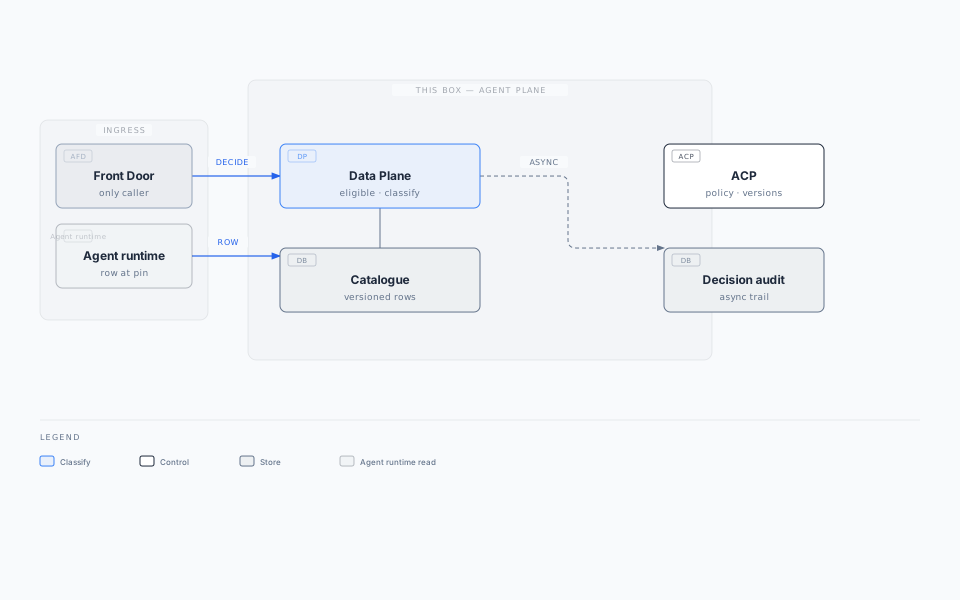
AFD calls classify, then freezes and starts. This plane does not call AR.
Key technology decisions
| Choice | Why |
|---|---|
| ACP ≠ Data Plane | Control/audit can lag. Classify must fail closed and stay on the hot path. |
| Plane does not pin or start | Pin sits on AFD. Start sits on AR. Decide SLO is classify, not work. |
| Versioned in-memory catalogue | Eligible set ∩ claims ∩ channel must be local. Origin QPS on every turn does not hold. |
| Cheap layers first | Layer ① bind, Layer ② retrieve (<50 ms), Layer ③ only if needed. Safety on every path. |
| Async decision audit | Decide SLO does not include "audit committed." Exam trail may lag. |
| Layer ③ on a separate pool | If saturated: clarify / abstain, not a slower ACP. |
| Jobs still hit Plane ① | Explicit route_id is not a skip of entitle + record. |
Expected outcomes
- One ingress decision for a shared experience.
- One versioned catalogue and one eval surface (golden set / CI).
- Operators can show eligible set,
router_layer, outcome, androute_table_version. - A down AR does not stop new turns. A down catalogue stops starts (correct).
This box owns / does not own
| Box | Owns | Does not own | If it dies |
|---|---|---|---|
| ACP | Policy, versions, decision audit (target) | Pin, start, loop, AFD hot-path classify | Audit lags; in-flight runs continue |
| Agent Data Plane | Eligible set, classify, route/workflow catalogue | Pin, start, loop | Classify fails closed |
| Decision audit | Async router_layer, outcome, eligible_routes (target) | Chat transcript | Decide still succeeds |
2. Two boxes
| Layer | Count | Why |
|---|---|---|
| Agent Plane | One per trust domain | Same eligible set, entitlements, eval, audit |
| Agent Control Plane (ACP) | One inside that plane | Control + decision record |
| Agent Data Plane | One inside that plane | Route/workflow catalogue + classify |
Three routers (do not collapse)
| Router | Question | Who calls it |
|---|---|---|
| Agent Data Plane | Which workflow / manifest / app? | AFD (classify). AR (row at pin, not classify) |
| Agent planner (inside AR) | Which tool / step next? | AR |
| Model router | Which LLM endpoint? | AR |
Data this plane owns
| Record | Who writes it | Lives where | Job |
|---|---|---|---|
| Decision | ACP | Audit store (target) | Why this turn routed, clarified, or abstained |
| Route/workflow catalogue | Platform / domain teams | Agent Data Plane | Versioned rows. Includes agent_client_id per row. |
Frozen route/session is on the AFD. Run pin is on AR. Capability versions are on the Agent Capability Plane (same Agent Plane band).
3. Classify
The Agent Data Plane classifies. Agent Front Door calls it, then freezes and starts. AR runs. 202 comes from AR, not from the data plane.
Decide = active table ∩ required_claims ∩ channel. Outcomes: route, clarify, abstain. Only route starts AR.
Classification runs only over eligible routes. Cheap layers first, safety on every path. The jobs API skips Layer ② / ③. It does not skip eligible, safety, or the decision record.

| Layer | Who sees it | Contents |
|---|---|---|
| ACP decision | AFD | outcome, and on route only: route_id, intent_label, route_table_version, confidence |
| Decision record | ACP / ops / eval | Full trace: router_layer, eligible_routes, safety_flags, latency_ms |
Chat/UI never sees route_id, run_id, confidence, or router_layer (FR-5).
4. Context
| Actor | Relationship |
|---|---|
| Chat AFD | Message + claims + session_id. May send route_id on hint tap / clarify pick (Layer ①). |
| API AFD | Explicit route_id + claims. Never receives clarify. |
| AR | GET catalogue row pointers at pinned route_table_version after start. Does not classify. |
| Platform / domain teams | Author versioned catalogue rows (agent_client_id, activation_target, manifest pointer). |
| Agent evals | Golden set and adversarial cases against this catalogue. CI gate. |
| Channels / browsers | No relationship. Not a public URL. |
5. Container / component architecture
| Component | Responsibility |
|---|---|
| Decide | Hot path. In-memory catalogue ∩ claims ∩ channel, then layers, then safety. |
| Eligible | Chat-visible ∩ claims ∩ channel. Event-only rows omitted. Used for chips, not start. |
| Catalogue row API | Pointers at a pinned version: activation_target, manifest, policy, model, memory, agent_client_id. |
| Layer ① | Bind: hint tap, clarify pick, jobs route_id, topic bind. |
| Layer ② | Retrieve. Budget < 50 ms. Local v1: keyword retrieve. |
| Layer ③ | Separate pool. Rare. Saturate → clarify / abstain. Local v1: deferred. |
| Safety | Every path, including jobs. |
| Audit publisher | Async. Full trace. Not on the decide clock. Local v1: not wired. |
Hot path. Whole eligible set in replica memory. Unreadable: fail closed. AFD is the only decide caller.
6. APIs
Module or internal RPC. Agent Front Door is the only decide caller. Do not pin. Do not start AR. Do not mint correlation_id.
| Method | Path | When / response |
|---|---|---|
POST | /v1/intent/decide | Every new decide. Chat: message + claims + session_id. Jobs: route_id + claims. Returns route, clarify, or abstain |
GET | /v1/intent/eligible | UI hints. Chat-visible ∩ claims ∩ channel |
GET | /v1/catalog/routes/{route_id} | After outcome=route only. Row pointers at route_table_version. AR reads this after start |
Chat with a frozen route/session and a continuation does not call decide.
Decide request: chat vs jobs (JSON)
{
  "ingress": "chat",
  "channel": "web",
  "session_id": "sess-88",
  "message": "Why was I charged $42?",
  "route_id": null,
  "claims": { "sub": "jane", "emts": { "accounts:read": true } }
}
{
  "ingress": "jobs",
  "channel": "api",
  "route_id": "contract_review",
  "claims": { "sub": "svc-legal-jobs", "emts": { "legal:msa_review": true } }
}
Decide response: route vs clarify (JSON)
{
  "outcome": "route",
  "intent_label": "fee_explain",
  "route_id": "fee_explain",
  "route_table_version": "2026.08.1",
  "confidence": 0.91,
  "eligible_routes": ["fee_explain", "account_history", "policy_qa"]
}
{
  "outcome": "clarify",
  "clarify_prompt": "Did you want a fee explanation or recent transactions?",
  "candidates": [
    { "route_id": "fee_explain", "label": "Explain a fee" },
    { "route_id": "account_history", "label": "Show recent transactions" }
  ],
  "eligible_routes": ["fee_explain", "account_history", "policy_qa"]
}
AFD channel APIs: Agent Front Door §6.
7. Deployment architecture
| Concern | Stance |
|---|---|
| Ingress | None from channels. AFD and AR only, private network / mesh mTLS. |
| Scale | Decide RPS + Layer ② latency. Three fleets: Chat AFD, API AFD, Agent Plane. |
| Catalogue rollout | Version bump, not turn rate. In-flight pins keep old versions via AFD. |
| Failover | Lose decide replicas: classify fails closed. Lose audit workers: decide still succeeds. |
| Isolation | Do not share an autoscaler with AFD or AR. Do not put Layer ③ on the Layer ② pool. |
Working order of saturation at hundreds of turns/s: (1) UI SSE on Chat AFD, (2) Layer ② CPU for free-text chat, (3) start-ack to a hot AR, (4) freeze KV, (5) Layer ③ — only if on the hot path. Do not.
8. Data architecture
Route / workflow catalogue
| Field | Why |
|---|---|
route_id | Stable name. |
route_table_version | Pin unit. |
required_claims | Entitlement. Not per-user rows in this table. |
channels / chat_visible | Eligible vs chips vs event-only. |
activation_target | Which AR. Omit = shared runtime. |
agent_client_id | Which robot. |
tool_manifest + version | Pointer. No inlined tools[]. |
autonomy_mode | Who decides the next step: 0–3. |
Consistency: Catalogue reads at a named version (pinned) are repeatable. AR and AFD must not re-read active after pin.
Local seed: route packs under agent-fabric-scripts/stack/route/. See author an agent.
9. Event / messaging design
Decide is synchronous RPC. Audit is the messaging path (target).
| Topic | Partition key | Producer | Consumer | Semantics |
|---|---|---|---|---|
agent.decision.recorded (working name) | session_id | ACP audit publisher | Audit store, eval | At-least-once. Decide already returned |
| Catalogue version published | route_table_version | Control pipeline | Decide replicas | Fan-out snapshot |
This plane does not consume {runs_topic} and does not produce job starts.
10. Sequence diagrams
Happy path — chat classify → route

Jobs entitle (no Layer ② / ③)
API AFD sends explicit route_id + claims. Data Plane looks up, entitles, and records. Missing claims → fail closed. No clarify.
11. Failure and resilience
| Failure | Behaviour |
|---|---|
| Decide replicas down | Classify fails closed. AFD returns 503. No guessed route. |
| Catalogue snapshot missing | Fail closed. |
| One AR down | Plane still accepts turns. AFD start-ack fails for that target only. |
| Audit lag / audit store down | Decide still succeeds. Exam trail lags. |
| Layer ③ saturated | clarify / abstain. Do not enqueue behind Layer ②. |
| Shared down | Unaffected. Routing still works. |
Anti-patterns: public Agent Plane URL; pin or start on ACP; re-read active after pin; scaling Layer ② by adding Layer ③ replicas; event-only rows on chat chips.
12. Scaling
Scale Chat AFD, API AFD, and Agent Plane as three fleets. Decide must not wait on a 12-step loop. Numbers: Enterprise Agent Fabric §3.
| Axis | Grows with | Scale signal |
|---|---|---|
| ACP | New decide RPS (Layer ①–②) | Decide RPS + Layer ② latency |
| Agent Data Plane | Catalogue reads at pinned version | Version bump, not turn rate |
| Decision audit | Decide RPS (async) | Queue depth. Lag is OK |
AFD and AR scale: Agent Front Door §12 · Agent Runtime §12.
Read next
Agent Runtime · Agent Capability Plane · Agent Front Door · Autonomy